The Open Book Symbol: A Brief Visual History
Trace how the open book symbol moved from medieval manuscript art into civic and educational emblems, and learn how context shapes its meaning.
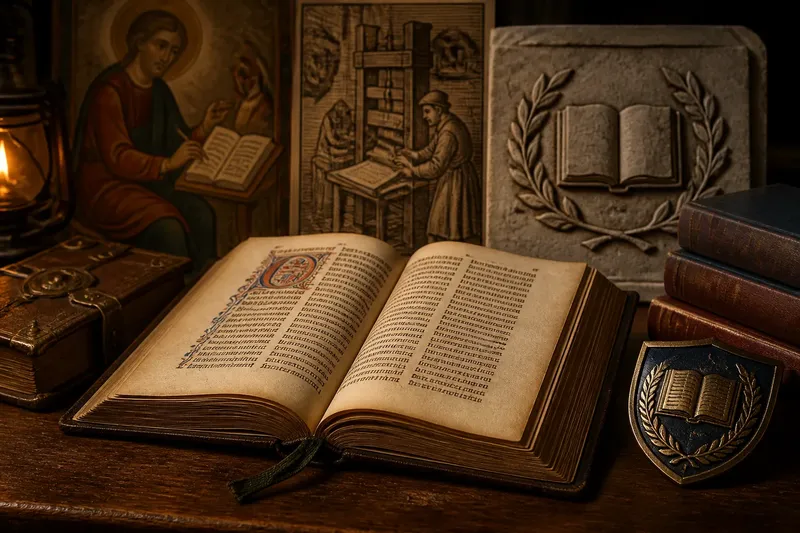
Why does the open book symbol suggest learning before we can read a word on its pages? Its familiar outline has a history: medieval artists pictured books in religious scenes, printers made books more visible in daily life, and later institutions adopted the open volume as an emblem of study. Each setting added meaning without fixing it forever.
To read the symbol well, look at its shape, its setting and the difference between an emblematic book and an actual one. A library sign, a school crest and a painted saint holding a book may share the same basic form, yet point towards different kinds of knowledge.
A shape made legible
An open book is easy to recognise even when an artist leaves out most of its detail. Two facing pages form a shallow V, with a central crease and edges that spread outwards. A few short marks can stand in for lines of writing. The image captures a book at the moment it seems ready to be read.
That open position matters. A closed volume can suggest something kept, protected or unavailable. An open one offers its contents to view, at least in principle. The viewer may not be able to read the marks, but can recognise an invitation to consult, learn or share.
The symbol compresses a larger idea into a small, clear form. It does not need to show a classroom, reader or library. That makes the open book useful on a sign, badge, seal or screen, where a detailed picture would be hard to recognise.
Medieval book images
In medieval European manuscript painting, books often appeared in scenes of teaching, worship and authority. Evangelists and saints were depicted with books or scrolls; in images of the evangelists, a book could identify a writer of sacred texts. The object did not simply mean reading. Its placement and the figure holding it connected the written word with religious teaching and authority.
Books were also represented as physical objects: closed covers, clasps, decorated surfaces and pages held open for a reader. These details reflected the forms artists saw around them. A painted volume could serve both as a recognisable object and as a sign that the figure possessed or transmitted important knowledge.
There was no single design that all communities used in the same way. A book in a devotional image belonged to its scene and tradition. Still, the repeated pairing of books with teachers, writers and sacred figures helped make the object available as a visual shorthand for learning and authority.
Print and public signs
Printing changed how books circulated and how often people encountered printed pages, though access varied by place, language and circumstance. As printed materials became more visible in public and institutional life, the book offered artists a familiar form to reuse. A simplified pair of pages could stand for reading without depicting a particular text or reader.
By the time schools and libraries used book imagery in signs and institutional designs, the open volume could signal study in a compact way. A library sign directs visitors towards reading materials; a university badge can present scholarship as part of the institution’s identity. Those uses carry the book’s older links with written authority, while giving the image a civic or educational emphasis.
The visual history is not a straight line from one medieval picture to one modern logo. Different artists and institutions have borrowed and adapted book forms for different purposes. The continuity lies in a recognisable object whose meaning is shaped by its neighbours: a lectern can suggest teaching, a religious emblem devotion, and a school name formal education.
Reading the details
The open-book image usually combines three suggestions. Visible pages imply access; marks on the pages imply written content; and the spread suggests that the content can be examined. But the symbol does not tell us who owns the book, who may read it or what its text says. It offers a broad idea of knowledge, not a complete account of how knowledge is shared.
Artists can shift the emphasis. Pages without writing may feel universal or unfinished. Dense lines can suggest scholarship or an archive. A large volume on a lectern can lend knowledge institutional authority, while a smaller book held by a figure can connect it with personal study. These are choices, not fixed rules.
Colour and framing matter as well. Stars around a book may suggest imagination or discovery; a religious sign nearby can make the image devotional. In an otherwise bare design, viewers may fall back on the broad association with literacy and education.
Say a community centre is choosing an icon for a reading group. The designer sketches an open book beside a circle of chairs, then removes a lectern from the design. The expected result is an image that feels more like shared conversation than formal instruction, because the chairs point towards people gathering around a text.
When does the open book mean learning?
Why does an open book suggest knowledge?
Its pages appear available for reading, while the written marks stand for information or ideas. The image distils the act of consulting a text into a shape viewers can recognise quickly.
Does a closed book mean ignorance?
No. A closed book can suggest privacy, rest, preservation or simply a book that is not being read at that moment. Calling it ignorance adds a judgement that the image alone does not require.
Why do schools and libraries use the symbol?
The open volume is a compact sign for reading and study, so it can identify an educational setting without showing a lesson in progress. Institutions can adapt the outline to their own names, colours and purposes.
Can an open book represent something beyond education?
Yes. In religious, legal or commemorative settings, it may suggest scripture, law, testimony or remembrance. The surrounding objects, words and figures help establish which association is intended.
Symbol and actual book
The emblem’s simplicity can obscure the variety of books in people’s lives. A volume may be a practical manual, a family Bible, a borrowed novel, a school workbook or an object kept for its inscription. Its meaning depends on its contents and relationships, not just on whether its covers are open.
An open book in a logo is generic by design. It stands for learning as a broad value, rather than the experience of reading a particular text. An actual book has a material history: it may be annotated, repaired, translated, inherited, shared or restricted. Those details can matter more to its owner than an abstract idea of knowledge.
There is also a difference between visibility and access. A symbol can make learning look open to everyone, while real access depends on factors the image leaves out: language, cost, disability, time, education and the availability of suitable texts. The emblem can express an aspiration, but it cannot by itself show who gets to take part.
Questions about book symbols?
What does an open book on a crest mean?
It often presents learning, scholarship or written authority as part of an institution’s identity. The crest’s name, motto and other imagery help narrow the meaning.
How can I tell whether a book symbol is religious?
Look for nearby sacred figures, signs or words, and consider where the image appears. A book alone does not identify a religious tradition or text.
Why are book symbols often drawn without readable words?
Generic marks keep the image legible at small sizes and avoid tying it to one language or title. They also make the book stand for reading broadly rather than for a particular text.
Context before assumption
A useful reading starts with observation. Notice whether the pages contain writing, whether someone holds or teaches from the book, and what symbols appear nearby. Then consider where the image is displayed: a classroom wall, public sign and ceremonial document invite different interpretations.
- Check the book’s position: If it rests on a lectern, read it first as a sign of teaching or public authority; if it floats alone, consider a general reference to learning instead.
- Check for a reader or teacher: If a figure studies the pages, the image may concern personal reading; if the figure addresses others, read it as instruction, while an absent figure leaves the emphasis broader.
- Check neighbouring signs: If religious symbols or sacred words appear, consider devotion; if civic names or school marks appear, consider institutional learning instead.
- Check the pages: If they carry dense lines or decoration, consider scholarship, record-keeping or sacred text; if they are blank, read the book more broadly, unless other details specify its purpose.
- Check the setting: If the image appears at a library entrance, it likely directs attention to reading resources; if it appears on a commemorative object, consider memory or honour instead.
- Check who the image addresses: If it appears on a notice asking people to join a reading activity, read it as an invitation; if it appears on an official seal, consider how the institution presents its authority instead.
Imagine a visitor sees an open book on a town library sign, with no person or religious emblem beside it. They first notice the spread pages and then the word “Library” beneath the image. The resulting reading is a general invitation to use reading materials, not a claim about one text or tradition; if the same book appeared with a sacred figure, the visitor would have reason to consider a devotional meaning instead.
The next time you encounter the open book symbol, notice what its pages cannot tell you. They may announce learning, but the people, texts and institutions around them show whose knowledge is being honoured. That distinction is the useful thread running through the open book symbol’s visual history: a familiar form travels, while its context decides what it says.