How to Read a Family Photograph Beyond the Faces
Read a family photograph beyond the faces with a simple close-looking routine that separates visible details from assumptions about relationships and events.
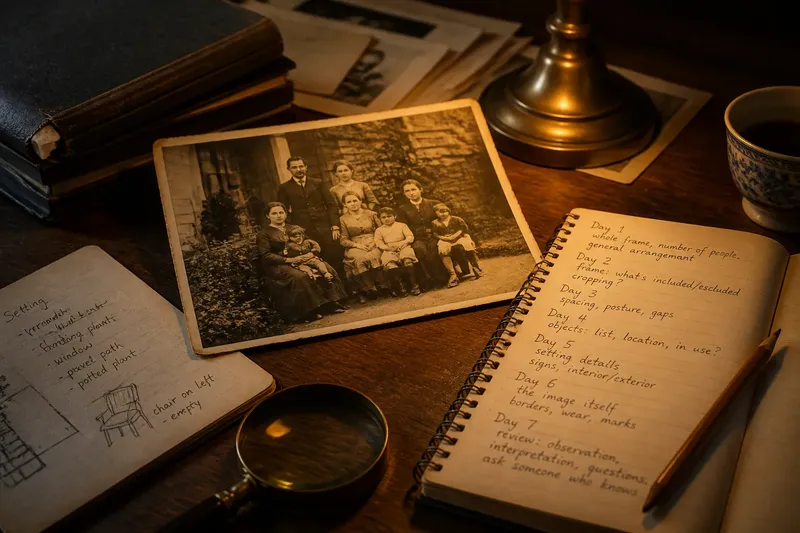
What can a family photograph tell you beyond who is pictured? To read a family photograph carefully, begin with what the image actually shows: its framing, objects, spacing and setting. Those details can offer useful clues, but they do not speak for themselves. A thoughtful routine helps you notice more without turning a guess into a family fact.
Set aside one photograph and return to it over the course of a week. A printed copy is handy because you can look closely without handling an original; a phone or tablet works too. Keep a notebook nearby. On the first look, resist the urge to identify everyone or explain the occasion. Your job is to make a record of visible details before you attach meaning to them.
A week with one photograph
The schedule below is deliberately unhurried. Short visits give your eyes a chance to notice different things, and the notes help distinguish observation from interpretation. If a detail remains unclear, leave it open rather than filling the gap with a confident-sounding story.
- Day one: Take in the whole frame. Write down the photograph’s general arrangement, the number of people you can see, and what occupies the edges. Note whether the image is a close portrait, a group arranged in rows, or a wider view with plenty of space around the figures. Avoid naming the event.
- Day two: Follow the frame. Look at what the camera includes and excludes. Are people cut off at the shoulders? Is there a doorway, table or patch of sky at the edge? Notice whether the group sits in the centre or appears slightly to one side. Cropping may reflect a photographer’s choice, a later trim or the limits of the camera’s position; the image alone may not settle which.
- Day three: Map the spacing. Note who stands or sits near whom, where gaps appear, and whether anyone leans in or turns away. Describe posture plainly: “two figures face the camera” is safer than “they are close”. Distance in a photograph can result from the arrangement, the furniture or the moment the shutter opened.
- Day four: Inventory the objects. List visible items such as a coat, cup, chair, bouquet, toy or suitcase. Record where each one sits and whether someone is holding, wearing or standing beside it. An object can prompt a question, but it cannot by itself identify an occasion or explain a relationship.
- Day five: Read the setting. Look for interior details, outdoor features, signs, decoration and practical clues such as a coat rack or picnic blanket. Separate what you can see from what you think the place might be. If a sign is legible, copy its wording rather than relying on memory.
- Day six: Check the image itself. Look for borders, fading, reflections, scratches, handwriting on the back or marks from an album mount. These may tell you something about how the photograph has been kept or handled. Do not treat a physical mark as evidence of when or why it was taken unless another source supports that idea.
- Day seven: Review and ask. Read your notes and mark each statement as an observation, a possible interpretation or a question. If someone who knows the photograph is available, ask an open question such as, “What do you remember about this room?” rather than offering your preferred explanation first.
Start with the frame
The frame is more than a border. It directs attention. A photograph that gives a person a large share of the image may make them seem central, while a wide view may emphasise the room, landscape or gathering. That is a description of visual emphasis, not proof that the person held a particular role in the family.
Check the edges as carefully as the centre. A hand entering from outside the frame, an empty chair or a partly visible figure can suggest that the photographer chose a tight crop or photographed a larger scene. It is tempting to decide who was behind the camera or why someone was left out. Unless you have another source, keep those ideas in the question column.
It also helps to distinguish the original composition from later presentation. A snapshot may have been trimmed to fit an album, and a digital image may have been cropped when it was shared. The visible frame is still worth describing, but it may not be the full scene the camera first captured.
Notice the objects
Objects can anchor close looking because they are often easier to describe than expressions. Note their shape, position and use: a bowl is on the table; a child has a ball; a person carries a folded umbrella. Then ask what is visible about the item itself. Is it in use, carefully arranged, or simply in the background?
Keep the difference between an object’s presence and its meaning. A cake might be part of a celebration, a shared meal or an ordinary afternoon. A suitcase might suggest travel, storage or a move, but the photograph does not tell you which. Family knowledge, a dated inscription or a related image may help; without that, write “possible suitcase” rather than “leaving for a trip”.
Objects can also show how people interacted with the photographer. Someone may hold a tool, display a dish or point towards a feature of the room. That action is visible. Whether it was spontaneous, requested or repeated for the camera is a separate question.
Read spacing with care
People’s placement can make a photograph feel formal, relaxed, crowded or sparse. Describe the arrangement before assigning a feeling. You might note that adults occupy the back row, a child sits near the centre, or two people share a bench. Those descriptions remain useful even if you never learn why the group stood that way.
Be especially cautious with empty space and physical distance. A gap between figures could reflect a chair, a camera angle, a photographer’s instructions or simply how people happened to stand. Likewise, a hand on someone’s shoulder does not settle whether the gesture was affectionate, practical or part of a posed arrangement. Ask what the image permits you to say, then stop at that boundary.
When the photograph shows several generations or a large gathering, avoid building a family tree from resemblance alone. Similar features can invite a question, but names and relationships are better checked with captions, family records or someone familiar with the people pictured.
What can the setting answer?
A setting may provide context without naming the event. Wallpaper, furniture, garden plants, a shop sign or a distinctive doorway can help you recognise a place or compare photographs. Start with details that can be checked: the sign’s words, the pattern of a curtain, or the position of a window.
Look for repeated visual clues across images, but keep each image’s evidence separate. The same chair appearing in two photographs may point to a familiar room. It does not establish that the pictures were taken on the same day. A caption, album sequence or family account could make that connection stronger.
If you are handling a fragile print, use clean, dry hands and avoid pressing on the image. For valuable or delicate photographs, ask an archivist or conservator about safe handling and digitisation. A careful scan can make close inspection easier while leaving the original less disturbed.
Questions about family photographs?
How can I tell when a family photograph was taken?
Begin with any date written on the print, album page or accompanying record, then compare it with visible clues such as clothing, furnishings or a readable sign. Treat those clues as leads rather than a date unless a reliable caption or family source confirms them.
Can spacing show who was closest in a family?
It can show how people were positioned for that particular image, but not necessarily the nature of their relationship. Describe the distance and posture first, then look for a caption or ask someone who knows the people pictured.
What if I do not recognise anyone?
Record the image’s details and check the album, envelopes and any writing on the reverse for names or context. You can also ask relatives whether the setting or objects look familiar, without suggesting identities as though they were certain.
Should I write my interpretation on the photograph?
Keep notes separately, especially if the print is old or fragile. If you add information to a digital copy, distinguish confirmed names from tentative identifications so later readers can see what is known and what remains uncertain.
Separate clues from stories
Imagine you find a photograph showing three people beside a table, with a small cake and a hand-written card partly visible. You write down the arrangement, the cake and the readable words on the card. The card includes a first name but no date. Rather than recording “a birthday party”, you note that it may be a celebration and ask a relative whether the name or room is familiar. The next conversation might clarify the occasion, or leave it unknown; either outcome preserves the visible details without making the image carry more than it can.
A simple two-column note can keep this habit clear. Put what you can point to in one column, and possible meanings or questions in the other. “A person holds a flower” belongs with observations. “They are visiting someone in hospital” belongs with interpretations, unless another source confirms it.
That distinction does not make a family photograph less meaningful. It gives the image room to remain complex: a record of people and a particular arrangement, shaped by a camera and whatever has survived around it. Read a family photograph beyond the faces by returning to the visible frame, objects, spacing and setting, then let family stories add context where they can. When the story is still unknown, a careful question is a useful piece of family memory in its own right.